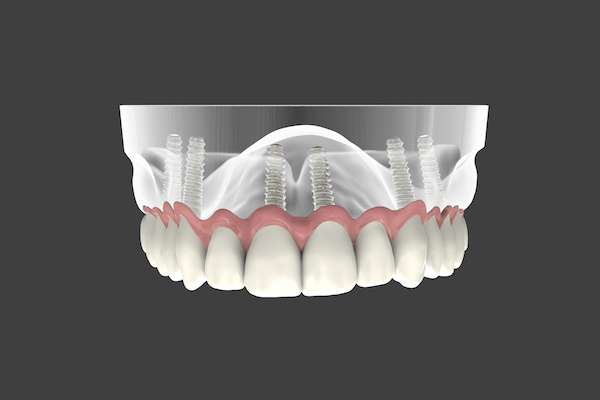
Unlike traditional dentures, implant supported dentures are, for the most part, permanent. The implants are permanently affixed to the jaw, although the patient can choose fixed or removable dentures. The method of placement is beneficial for many reasons, and the result is a more natural look and fit than regular dentures.
Benefits of implant supported dentures
The dentures are connected to dental implants, which are attached to the bone. This results in a number of benefits over traditional dentures:
- Preserves the jawbone and prevents facial structure deterioration
- Eliminates the need for adhesives
- Increases stability, which restores natural chewing ability
- Provides a natural look
- Allows for a better fit, which prevents mouth and gum sores
- Enhances self-confidence
Implant supported denture procedure
There are numerous considerations to think about when deciding how to replace missing teeth. For those who decide on
implant supported dentures, the process requires several steps.
Consultation
Not everyone is a candidate for implant supported dentures. At the initial consultation the dental professional determines if a patient is qualified for the procedure and also goes over alternative options.
A good candidate is someone who is missing multiple teeth and has adequate jawbone density to support the implants. A person should also be diligent with good oral hygiene, not have underlying health conditions and be a nonsmoker.
Teeth extraction
This step is only for those who are using dentures to replace damaged or diseased teeth. These teeth are removed and, once the extraction site has healed, the implants are placed into the jaw.
Implant placement
Dental implants are small titanium screws that the dentist surgically inserts into the jawbone. Depending on if the dentures are going into the upper jaw or lower jaw or both, the number of implants placed typically range from four to 13. After placement, there is a healing process that allows the bone and gums to grow around the implants. This can take anywhere from three to six months.
Denture fabrication
Once the gums have healed, the dentist takes an impression of the teeth and makes a wax model to ensure the final dentures fit well. The mold is sent to a lab where the dentures are made from natural-looking materials.
Hardware attachment
After gum healing, hardware, known as an abutment, bar or snap, is attached to the implants. During the process, the gum tissue is reopened to expose the implant and then the hardware is attached. This area then needs to heal, which takes an average of two weeks.
Tooth restoration
The final step in the procedure is to place the custom-made dentures to the hardware. The dentist makes any final adjustments so the fit is secure and comfortable.
Implant supported dentures are one way to replace missing teeth and restore normal function. Patients should properly care for the dentures by brushing, flossing and visiting the dentist twice a year. Doing this reduces plaque buildup and enhances the life span of the dentures, which typically ranges from 10 to 20 years.
Related Posts
You have tried whitening strips, whitening toothpaste, and maybe even a professional treatment. Yet your smile still looks dull or discolored. If you are wondering why your teeth whitening isn't working, intrinsic vs. extrinsic stains in Boca Raton could be the answer. Not all stains respond to whitening the same way — and understanding the…
If you are considering full-mouth restoration in Boca Raton, one of the first questions you probably have is: how long will the results actually last? It is a fair and important question. You are investing in your smile, your health, and your quality of life. Understanding the longevity of full-mouth restoration results in Boca Raton…
If you've been wondering why your dentures feel loose after a few years in Boca Raton, you're not alone. Many denture wearers notice a gradual change in fit over time. What once felt secure begins to slip, shift, or even cause soreness. Understanding why this happens — and what you can do about it —…